How to make money with AI video using Sora 2 and Veo 3.1. Compare business models, workflows, and roadmaps to reach $10k/month.
As marketers sprint into the holiday crush of 2025 and plan for 2026, one truth is loud and clear: you can make money with AI video. Not by dabbling, but by building repeatable workflows that turn prompts into revenue. In Vibe Marketing terms—where emotion meets intelligence—AI video lets you scale feeling, format, and performance without scaling headcount.
This guide breaks down what's working now and what will matter most in 2026. We'll compare Sora 2 and Veo 3.1, map the top three business models, and give you roadmaps to reach $10k/month. You'll also get a practical "video agent" workflow that turns tools like InVideo AI and Fal.ai into an autonomous director, editor, and sound designer.
If you're a brand, creator, or agency looking to ride the seasonal wave and set the tone for Q1, this is your playbook.
Why AI Video Is the 2026 Gold Rush
AI video is no longer a novelty. Short-form and mid-form formats now power product discovery, social proof, and community-building across every channel. Two forces are driving the gold rush:
- Production collapse: What once took crews, cameras, and weeks now takes prompts, iterations, and hours.
- Distribution appetite: Platforms reward native video that delivers watch time, emotion, and novelty. AI helps you hit all three, fast.
From a Vibe Marketing perspective, the opportunity isn't just more content—it's consistent feeling at scale. AI video lets you test three vibes in a day: cozy ASMR for gifting season, kinetic UGC-style demos for performance ads, and cinematic story spots for brand memory. The winners inform your 2026 content system.
Sora 2 vs. Veo 3.1: Strengths, Use Cases, ROI
Both Sora 2 and Veo 3.1 are elite, but they excel at different "vibes" and business outcomes.
When to Choose Sora 2
- Physics-aware product demos: Liquids, textures, and object interactions feel believable—perfect for UGC-style ads.
- Creator-first formats: Talking-head explainers, unboxings, lifestyle B-roll, and social slabs.
- Iterative testing: Quick variant generation for ad creative and thumbnails.
Business edge: Faster concept-to-ad cycles, lower CPM waste, and higher thumb-stop rates for performance media.
When to Choose Veo 3.1
- Cinematic storytelling: Depth, mood, and pacing built for brand films and sensory content.
- ASMR and ambiance: Rich audio-visual coherence for relaxing loops and premium brand cues.
- Controlled transitions: Start/end frame control unlocks scene-to-scene magic.
Business edge: Emotional memory, longer watch times, and premium-feeling assets for brand campaigns.
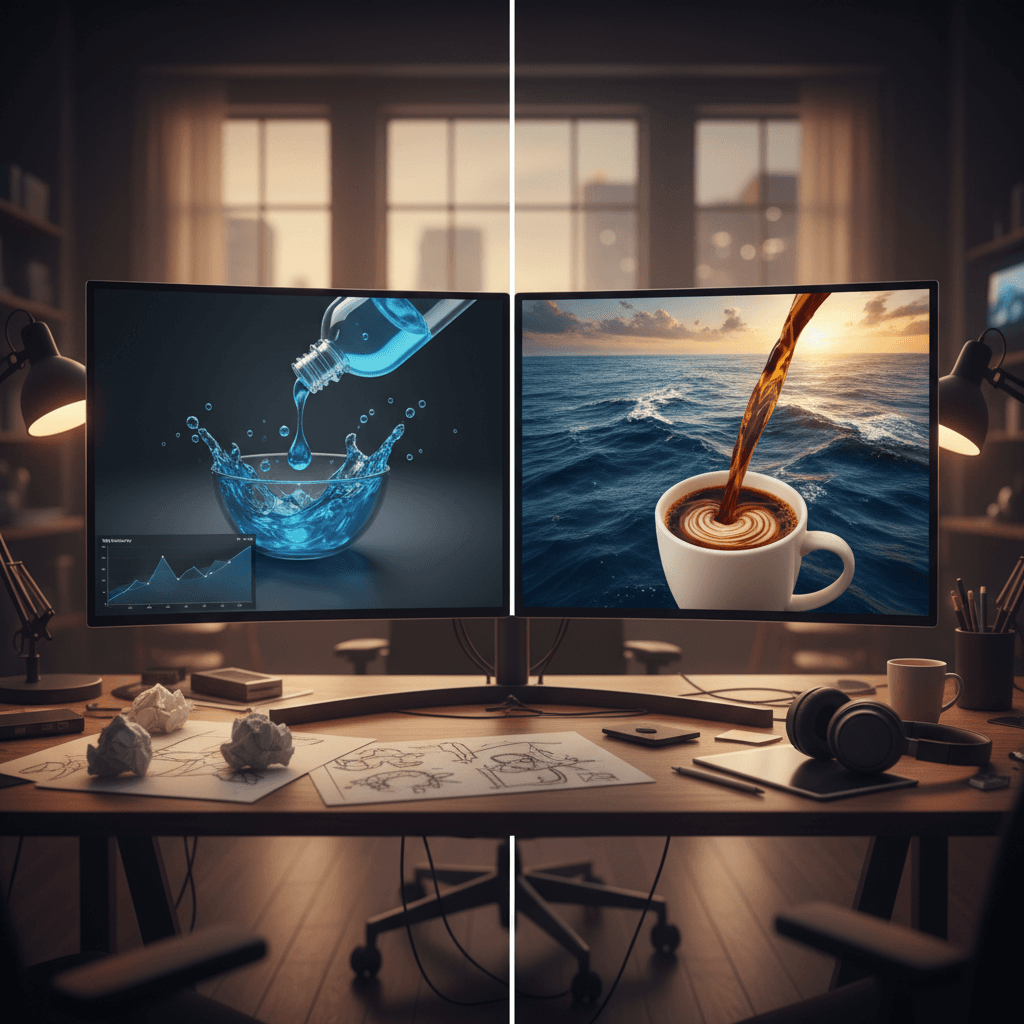
Start/End Frame Transitions (the "Which Ocean?" effect)
The trend: seamless scene swaps that feel like a single take. Here's how to replicate it with Veo 3.1:
- Define A→B transition: e.g., "Close-up of rippling coffee surface" → "Aerial blue ocean currents."
- Set your start frame: a high-contrast, detailed shot with clear motion cue.
- Set your end frame: same texture family (waves to waves, steam to mist) to preserve visual logic.
- Match camera behavior: consistent dolly or pan to conceal the cut.
- Layer soft Foley: ocean hush blending into steam hiss; keep amplitude steady.
- Export variants: test 0.8x, 1x, and 1.2x pacing for platform-specific watch loops.
Pro tip: Add on-screen prompt beats ("Guess which ocean?") in the editor, not the generator, so text remains crisp.
The Top 3 AI Video Business Models
1) Viral Content Studio
- Offer: Trending short-form series for brands and creators (3-5 formats, 15-30 assets/mo).
- Why it works: Trend velocity + format libraries + AI generation = predictable virality attempts.
- Pricing: $2,000–$6,000/mo retainer per brand depending on volume and rights.
- KPIs: 3-second hold, 50% watch-through on <15s, saves/shares, and creative testing velocity.
- Risks: Trend fatigue and platform shifts—mitigate by keeping 40% evergreen formats.
Use Sora 2 for UGC/product snippets; Veo 3.1 for opening hooks and transitions that elevate.
2) AI Creative Agency (Brand Films + Ad Systems)
- Offer: Strategy + scripts + cinematic brand spots + cutdowns + performance variants.
- Why it works: Brands want emotion that scales into performance media.
- Pricing: $5,000–$25,000 per campaign; maintenance retainers for monthly iterations.
- KPIs: Brand lift proxies (mentions, recall surveys), blended CPA, and watch time.
- Risks: Over-stylization—solve with decision trees tied to messaging and ICP.
Lead with Veo 3.1 for master spots, then generate Sora 2 cutdowns for ad testing.
3) Faceless YouTube Automation
- Offer: Research-driven, voiceover-led channels across niches (tech explainers, cozy finance, ambient study).
- Why it works: AI compresses scripting, visuals, and sound design.
- Monetization: Ad revenue, affiliates, info products, sponsorships.
- KPIs: AVD (average view duration), CTR on thumbnails, RPM, returning viewers.
- Risks: Content sameness—differentiate with narrative angles and audio identity.
Pair Veo 3.1 for cinematic segments or ASMR loops and Sora 2 for explainers and B-roll.
The Video Agent Workflow (InVideo AI + Fal.ai)
Turn your stack into an autonomous production line. Adapt this baseline for any model:
- Brief to beats: Convert briefs into a 6–10 beat outline (hook, tension, reveal, proof, CTA).
- Prompt packs: Create reusable "style DNA" prompts (lighting, lens behavior, pacing, palette).
- Visual generation: Use Sora 2 for demos/UGC and Veo 3.1 for cinematic scenes and transitions.
- Frame control and continuity: For transitions, lock start/end frames and camera moves.
- Edit assembly: Your video agent (InVideo AI or Fal.ai) arranges clips, applies timing rules, and exports rough cuts.
- Sound design: Auto-bed music and Foley, then manually polish the hook and crescendo.
- Brand layer: Add motion branding: colors, lower thirds, mnemonic sting.
- QA and compliance: Check likeness rights, stock licensing, disclaimers, and platform-safe audio.
- Variant factory: Spin 3–6 hooks, 2 lengths (9–12s and 20–30s), and square/vertical formats.
Operational tip: Name assets by beat and intent (e.g., B2_Hook1_UGC) so testing data flows back into your prompt library.
From $0 to $10K/Month: Roadmaps You Can Follow
Pick one model and focus for 90 days. Here are realistic paths.
Viral Content Studio Roadmap
- Weeks 1–2: Build 3 signature formats (trend remix, product POV, ASMR loop). Create a 30-asset portfolio. Price 2 tiers.
- Weeks 3–6: Land 3 pilot clients at $1,500 each for 10–15 assets. Overdeliver on hooks and transitions.
- Month 3: Convert 2 pilots to $3,000/mo retainers; add 1 new retainer. Target: $9,000–$12,000/mo.
- Cost stack: Generators + editing agent + music library + storage—optimize to <$400/mo. Time is your true cost.
- Growth lever: Publish weekly "format drops" to showcase results and keep pipeline warm.
AI Creative Agency Roadmap
- Weeks 1–2: Define 2 lanes: cinematic brand film and performance ad system. Produce one hero case study and 6 cutdowns.
- Weeks 3–6: Pitch 10 prospects with a "Storyboard + 10-second spec" offer. Close 2 at $4,000–$7,500.
- Month 3: Package a $12,000 master spot + $3,000 ad variant retainer. Target: $10,000–$18,000/mo.
- Cost stack: Higher compute and manual polish; budget $600–$1,200/mo for tools/compute.
- Growth lever: Offer a "creative testing sprint" that guarantees 20–40 ad variants in 7 days.
Faceless YouTube Automation Roadmap
- Weeks 1–2: Choose a niche with clear RPM and affiliate potential. Ship 6 videos (6–10 minutes) to lock structure.
- Weeks 3–6: Publish 2–3 videos/week. Develop a strong audio identity (voice, music bed, UI sounds).
- Month 3: Aim for 50–100k monthly views; add affiliates and one sponsor. Target: $1,500–$4,000/mo with upside.
- Cost stack: Voice model + video agent + thumbnail design—keep to <$300/mo early.
- Growth lever: Build a "pillar series" (10–12 parts) to lift session watch time and returning viewers.
Guardrails that protect profit: Disclose AI use when required, secure likeness/brand permissions, avoid deceptive claims in product demos, and store prompts/settings for reproducibility.
Quick ROI Math You Can Trust
- Retainer math: 4 clients × $2,500/mo = $10,000/mo. Your variable cost per client should stay under 15%.
- YouTube math: 100k views × $8 RPM ≈ $800 ads; add $1,500 affiliates/sponsors for $2,300. Scale via publishing cadence and series depth.
Bringing Vibe to the Machine: Final Notes
Vibe Marketing is about emotional precision at scale. Sora 2 gives you physics-believable product moments and creator-native energy. Veo 3.1 delivers cinematic narratives and ASMR that people remember. Together—and paired with a video agent—you can make money with AI video while building brand equity, not just views.
Your next step: pick one model, ship a 10-asset mini-portfolio this week, and talk to three buyers. If you want more depth, subscribe to our newsletter and join our community to get templates and workflows.
The 2026 winners will be those who master both vibe and velocity. Which format will you test first this week—and what emotion will you scale?