Microsoft, Nvidia, and Anthropic team up to bring Claude to Azure at scale. Here's how to turn the alliance into real productivity gains for 2026.
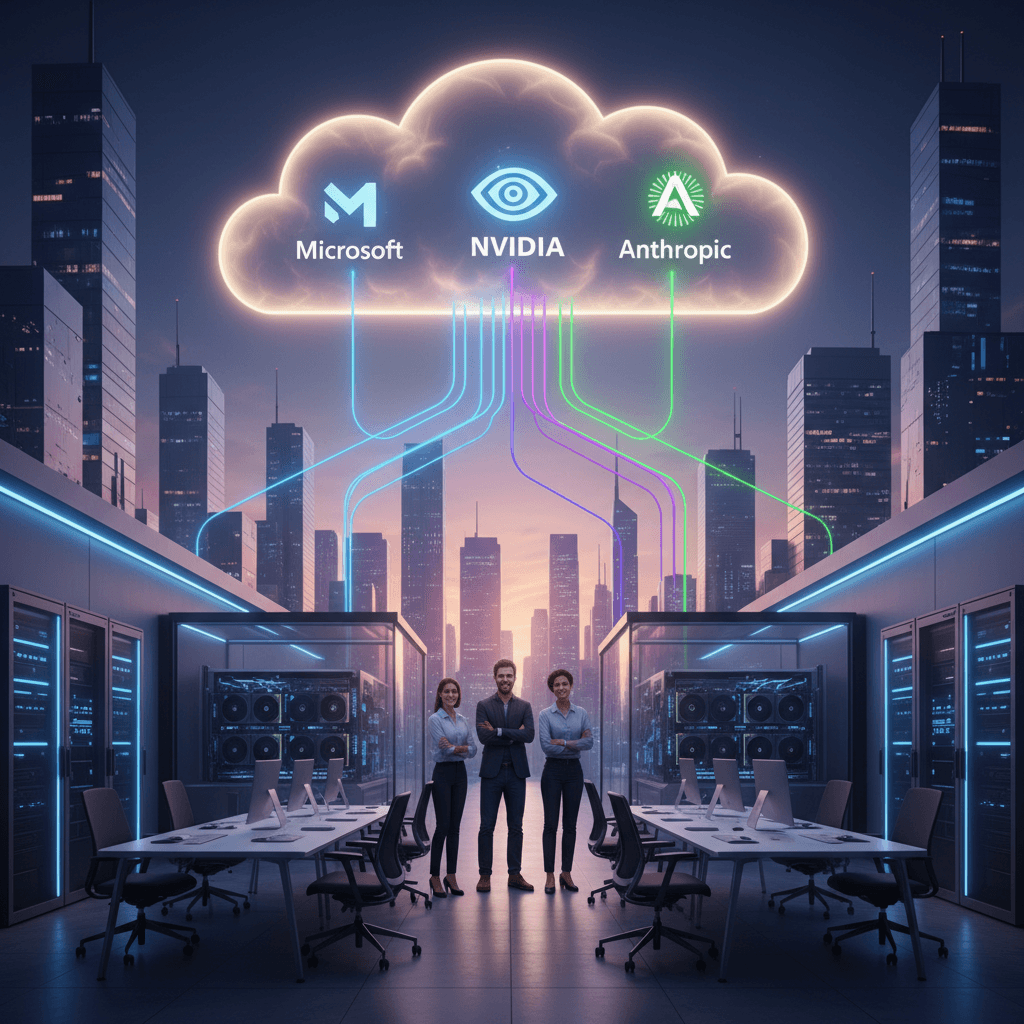
"A dream come true" isn't hyperbole when three of the biggest forces in AI—Microsoft, Nvidia, and Anthropic—align. For leaders racing to boost productivity without ballooning costs, the Microsoft Nvidia Anthropic AI alliance signals a new phase: enterprise-scale AI that's faster to deploy, easier to govern, and powerful enough to transform daily work.
In our AI & Technology series, we focus on practical ways AI upgrades your workflow. This development matters because it marries three things businesses care about right now: best-in-class models (Claude), reliable cloud operations (Azure), and unrivaled performance per dollar (Nvidia acceleration). As 2025 closes and 2026 planning begins, it's the rare headline that can actually change your roadmap.
In this post, you'll learn what this alliance means, the immediate opportunities it unlocks, and a playbook to pilot, prove, and scale AI for real productivity gains—without derailing budgets or compliance.
What this AI alliance really means for enterprises
Microsoft, Nvidia, and Anthropic have struck a multibillion-dollar agreement to scale Anthropic's Claude models on Azure, powered by Nvidia's latest AI accelerators. In plain terms: you get access to frontier models through enterprise-grade infrastructure that can meet security, compliance, and performance requirements.
Why this combination matters
- Choice without chaos: If your teams already use Azure for identity, security, and data, bringing Claude into that environment reduces integration friction compared to adding yet another vendor stack.
- Performance that lowers TCO: Nvidia's GPUs and associated software stacks are the industry standard for training and high-throughput inference. Higher throughput can mean lower unit costs for production workloads.
- Governance and safety: Anthropic is known for model safety research while Azure provides robust enterprise controls—policy, logging, private networking, and confidential computing options—to protect data.
What you should expect (and ask)
- Access to Claude through Azure's model catalog and managed endpoints.
- Clear options for fine-tuning, tool-use, and retrieval augmentation.
- Transparent pricing for both development and scaled inference, including burst capacity for peak seasons.
Why it belongs in your 2026 productivity plan
Most organizations are beyond the "demo" stage. The constraint now is operationalizing AI safely and cost-effectively. This alliance addresses three blockers:
- Procurement and risk: Buying through an established cloud reduces contractual complexity.
- Latency and throughput: Nvidia acceleration helps hit SLA targets for customer-facing features.
- Model breadth: Claude's reasoning and writing strengths complement other models you may already run, improving task coverage across your organization.
Productivity impact you can measure
- Task completion speed: Drafting, summarization, and decision support see 30–70% time savings when grounded in your data.
- Quality uplift: Claude's strong instruction-following often reduces revision cycles for customer communications, knowledge articles, and code reviews.
- Cost-to-serve: Higher inference efficiency enables more automation per budgeted dollar, especially in contact centers and back-office processing.
Five high-ROI workflows you can build now
Use these as blueprints to turn the alliance into outcomes for work and productivity.
1) Customer support copilot
- What it does: Drafts empathetic responses, cites policy, and auto-updates tickets.
- Stack pattern: Claude endpoint on Azure, retrieval via your knowledge base, action tools for ticket updates.
- KPI: First-contact resolution, handle time, and customer satisfaction.
2) Document intelligence for operations
- What it does: Ingests PDFs, contracts, and SOPs; answers complex, multi-step questions with citations.
- Stack pattern: Azure storage + vector retrieval, Claude for reasoning, audit logs for compliance.
- KPI: Time-to-answer, error rates, and compliance exceptions.
3) Sales and marketing content engine
- What it does: Generates on-brand proposals, micro-campaigns, and competitive briefs tailored to account data.
- Stack pattern: Claude with style guides, product data grounding, human-in-the-loop approvals.
- KPI: Cycle time from brief to asset, win-rate lift in targeted segments.
4) Software delivery assistant
- What it does: Suggests code changes, writes unit tests, and explains diffs in plain English.
- Stack pattern: Secure code retrieval, Claude for reasoning, gated write permissions.
- KPI: Lead time for changes, escaped defects, developer satisfaction.
5) Risk and compliance analyzer
- What it does: Reviews policies, flags inconsistencies, and drafts mitigations with references.
- Stack pattern: Private knowledge store, Claude for structured critiques, workflow approvals.
- KPI: Audit readiness time, issue resolution cycle, policy coverage.
A 30/60/90-day plan to capitalize on the alliance
Move fast—without breaking governance.
Days 0–30: Prove value with a narrow, grounded pilot
- Identify one high-friction workflow with measurable outcomes.
- Prepare a minimal, high-quality knowledge set (10–50 canonical docs).
- Build a retrieval-augmented prototype with strict role-based access.
- Define success metrics and a budget cap. Run shadow mode alongside humans.
Days 31–60: Industrialize the pipeline
- Add observability: prompt, latency, cost, and outcome dashboards.
- Introduce evaluation harnesses (gold answers, red-team prompts, toxicity checks).
- Implement prompt versioning, secrets rotation, and incident playbooks.
- Run A/B tests across model settings to find the performance/cost sweet spot.
Days 61–90: Scale and govern
- Expand to adjacent workflows; templatize prompts and retrieval schemas.
- Negotiate committed-use pricing and capacity reservations for peak loads.
- Formalize data retention, PII handling, and model access policies.
- Train champions in each business unit to drive adoption and feedback loops.
Architecture patterns that work on Azure
Retrieval-augmented generation (RAG) as the default
- Store: Use an enterprise-grade vector or index service with partitioning by tenant.
- Prepare: Chunk documents with metadata (owner, sensitivity, effective date).
- Generate: Have Claude cite sources and explain reasoning steps.
- Guard: Apply content filters and reject unsupported claims.
Tool-use and workflow orchestration
- Let the model call functions for ticket updates, CRM notes, or data lookups.
- Enforce least-privilege on each tool and log every call for audits.
Cost and latency tuning
- Cache frequent results; stream partial responses for better UX.
- Right-size contexts; use re-ranking to reduce token spend.
- Benchmark across model sizes; reserve capacity for predictable loads.
Risks, realities, and how to de-risk your bet
All alliances promise a lot. Here's how to make sure you get the value.
Cost control
- Set per-team budgets with alerts; track cost per successful action.
- Prefer batch processing for non-urgent jobs; stream only when necessary.
Vendor strategy
- Maintain a model-abstraction layer to avoid lock-in.
- Keep data portable; document runbooks for migration if needed.
Security and compliance
- Enforce private networking, encryption, and data minimization.
- Use human-in-the-loop for high-impact decisions; log and review exceptions.
Quality and bias
- Maintain golden datasets for evaluation.
- Review outputs for fairness, toxicity, and hallucination rates; iterate prompts and retrieval.
The bottom line—and your next move
The Microsoft Nvidia Anthropic AI alliance is more than a headline. It's a practical way to bring frontier models like Claude into your existing Azure estate with the performance and governance today's enterprises require. For teams focused on work and productivity gains in 2026, this is a high-leverage path: fewer integration headaches, better throughput, and safer deployment patterns.
If you're ready to operationalize AI, start with a single workflow, prove measurable ROI, and scale with strong guardrails. Our AI & Technology series will continue to share blueprints you can adapt. Want a tailored 90-day AI productivity plan for your organization? Reach out to schedule a working session and we'll map the quickest route from pilot to production.
The next wave of competitive advantage goes to those who can turn alliances like this into outcomes. How will you use it to work smarter—not harder—in 2026?