Three new battery projects totalling 720MW signal Australia's next grid-scale storage wave—blending lithium-ion hardware, AI and policy under the EPBC Act.
Australia's 720MW Battery Push and the Future Grid
As Australia races toward a cleaner energy future, three new large-scale battery projects, totalling 720MW of capacity, have entered federal environmental assessment under the EPBC Act. On paper that's just another line in a regulatory register. In practice, it's a clear signal that grid-scale energy storage – and the green technology behind it – is moving from pilot projects to national infrastructure.
These battery energy storage systems (BESS), proposed in New South Wales and Western Australia and linked to major players like AGL Energy and TagEnergy, are not just about storing surplus solar and wind power. They are about stabilising an increasingly complex grid, cutting emissions, and opening new business models in the clean energy economy.
In this post, part of our Green Technology series, we unpack what these 720MW of batteries really mean. We'll explore how large-scale storage works, why the EPBC Act process matters, and how AI and digital intelligence are turning batteries into smart, revenue-generating assets that can help businesses and communities thrive in a low‑carbon world.
1. Why 720MW of Battery Storage Matters Right Now
Australia is already a global benchmark for rooftop solar and rapidly expanding wind capacity. But the more variable renewable energy you add, the more you need flexible, fast-responding storage.
A combined 720MW of new grid-scale batteries is significant because it can:
- Shift large volumes of solar energy from midday to evening peaks
- Provide millisecond-fast response to balance supply and demand
- Support the retirement of aging coal plants without compromising reliability
- Reduce reliance on expensive and polluting gas peaker plants
From "nice-to-have" to critical infrastructure
Just a few years ago, grid batteries like the original Hornsdale Power Reserve were seen as bold experiments. Today, they are recognised as:
- Essential for grid security – providing frequency control and voltage support
- Key tools for emissions reduction – enabling higher penetration of wind and solar
- Strategic assets for energy retailers and generators managing price volatility
These three new projects entering federal assessment show that battery storage is being planned at system scale, not just as isolated demonstrations.
The timing: 2025 and the changing grid
By late 2025, several Australian coal units will be closer to retirement, while electrification of homes, vehicles and industry continues to accelerate. More air conditioners, EV chargers, data centres and electric machinery all push up peak demand.
In that context, adding hundreds of megawatts of fast, flexible battery capacity is not optional – it's foundational to a resilient, decarbonised grid.
2. How Grid-Scale BESS Work – and Why Location Matters
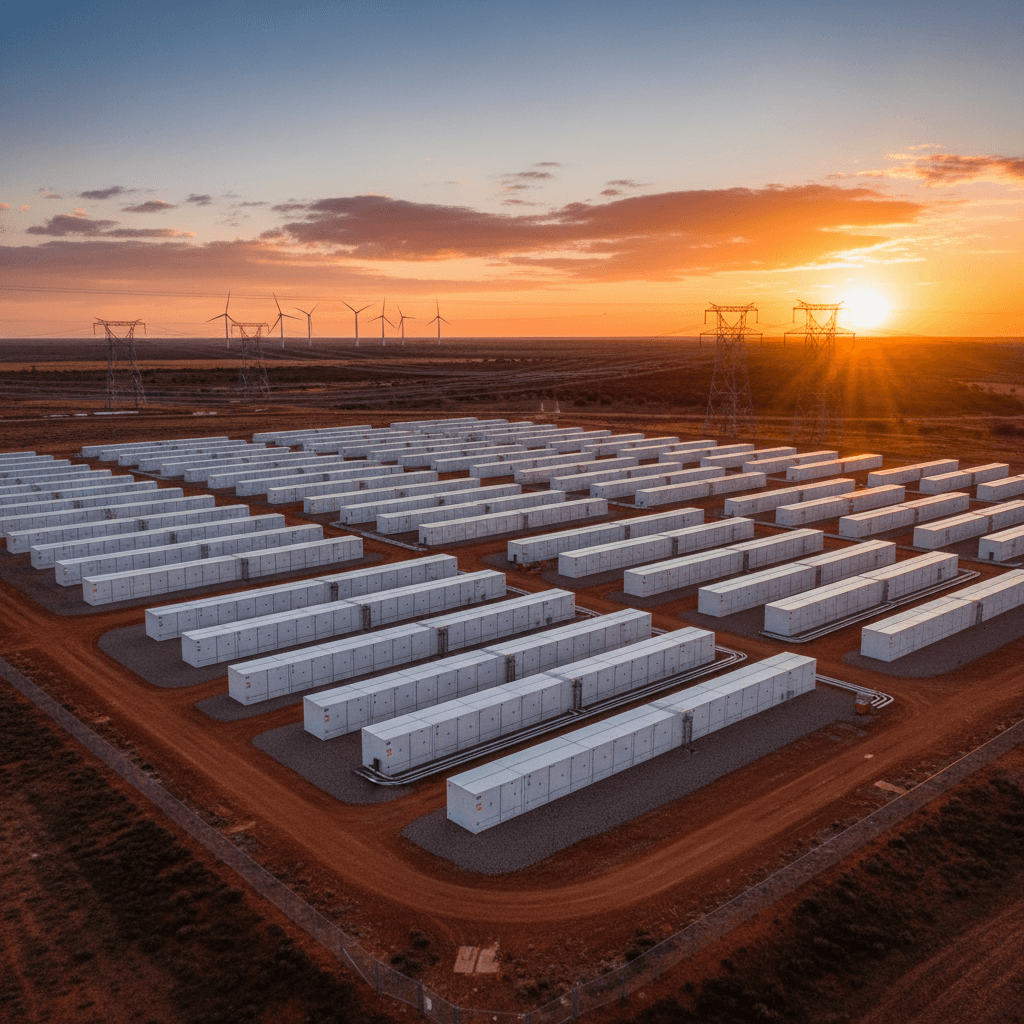
Most large Australian batteries today use lithium‑ion technology, similar in principle to what powers your smartphone or EV, but configured in containerised racks with sophisticated control systems.
What a 720MW portfolio can actually do
While exact project configurations vary, a utility-scale BESS typically offers:
- Power (MW): How much it can deliver at any instant
- Energy (MWh): How long it can sustain that output
A 240MW battery with a 2-hour duration, for example, provides 480MWh of energy. Across three projects totalling 720MW, you might see 1,440–2,880MWh of usable storage depending on design – enough to:
- Cover evening demand for hundreds of thousands of homes
- Firm intermittent wind and solar over critical peak periods
- Provide emergency backup during outages or transmission constraints
Strategic sites: New South Wales and Western Australia
The RSS summary flags New South Wales and Western Australia – two very different but complementary markets:
- NSW: Rapid coal plant retirements, heavy demand centres (Sydney/Illawarra), and strong growth in large-scale renewables. Batteries here can stabilise the grid as coal exits and support new Renewable Energy Zones.
- WA: An isolated grid (the SWIS), strong rooftop solar penetration, and limited interconnection options. Storage in WA is crucial because the state cannot simply import power from other regions.
Placing BESS near load centres, renewable hubs, or constrained transmission nodes lets them provide maximum grid value – from relieving congestion to improving power quality.
3. The EPBC Act: Environmental Guardrails for the Storage Boom
All three projects have been submitted for assessment under Australia's Environment Protection and Biodiversity Conservation (EPBC) Act. For developers, this can seem like a hurdle. For the green technology transition, it's a necessary safeguard.
What the EPBC Act process involves
When a project goes to the EPBC process, regulators examine potential impacts on:
- Matters of national environmental significance, such as threatened species and ecosystems
- Water resources, especially if associated with coal seam gas or large mining
- Heritage and community values, including Indigenous cultural heritage
For batteries, key assessment issues often include:
- Site disturbance and land-use change
- Visual and noise impacts
- Construction traffic and local amenity
- Fire safety and emergency management plans
If approved with conditions, projects must implement mitigation measures, monitoring, and community engagement.
In a truly sustainable energy transition, how we build is as important as what we build.
Why environmental assessment is a competitive advantage
Far from being just a regulatory checkbox, rigorous environmental assessment can actually improve project bankability and social licence:
- Investors gain confidence that risk has been systematically managed
- Local communities see their concerns reflected in design and operation
- Developers surface environmental constraints early, reducing redesign costs
For businesses participating in the green technology ecosystem – whether as suppliers, service providers, or off-takers – working with projects that clear EPBC scrutiny can reduce long-term reputational and operational risk.
4. AI, Data and the Rise of the "Smart Battery"
What makes these new BESS truly transformative is not just the hardware. It's the software, AI and analytics that sit on top, turning static storage into a dynamic grid services platform.
AI-optimised dispatch and revenue stacking
Modern batteries participate in multiple markets at once:
- Energy arbitrage (buy low, sell high)
- Frequency control ancillary services
- Fast frequency response and inertia-like services
- System strength and voltage support
AI and machine learning models are increasingly used to:
- Forecast prices, demand and renewable output
- Optimise when the battery charges, discharges or stays idle
- Automatically switch between markets in real time to maximise returns
For operators like AGL Energy and TagEnergy, this digital layer is crucial. It lets them treat storage as a flexible, data-driven asset, not just a big battery on a hill.
Grid stabilising intelligence
For system operators, AI-powered BESS controls can:
- Detect frequency deviations within milliseconds
- Coordinate fleets of batteries across regions
- Prioritise responses based on system-wide conditions
This is where our Green Technology theme truly converges: AI is the brain that allows clean energy hardware – solar, wind, batteries, EVs – to operate as one integrated, stable system.
For businesses, this means new opportunities:
- Corporate PPAs that bundle renewables with firming from smart storage
- Demand response programs that use AI to align consumption with green power
- Behind-the-meter batteries that coordinate with grid-scale assets for shared value
5. What This Means for Businesses, Investors and Communities
The entry of three new 720MW-class batteries into federal assessment is more than a news item. It's a signal of where policy, capital and technology are converging.
For businesses and large energy users
- Expect more flexible contracts: Retailers and generators will increasingly offer products combining renewable energy with storage-backed reliability.
- Prepare for dynamic pricing: As storage grows, intraday price spreads will change. Energy-intensive businesses can benefit by aligning operations to AI-optimised price signals.
- Consider on-site or portfolio participation: Even if you don't host a battery, you can participate virtually through aggregated demand response or storage-backed PPAs.
For investors and project developers
- Regulatory literacy is essential: Understanding the EPBC Act and state planning regimes is as important as knowing battery chemistries.
- Digital capability is a differentiator: Projects with strong AI, forecasting and control systems will extract more value and manage risk better.
- Portfolio thinking beats one-off assets: Integrating storage with wind, solar and flexible demand creates more resilient revenue streams.
For communities and local stakeholders
- Engagement early and often pays off: Communities that participate in consultation can help shape outcomes on visual impact, noise, access and benefit-sharing.
- Batteries enable more local renewables: Storage can reduce curtailment of local solar and wind, translating into regional economic activity and jobs.
6. Practical Next Steps: Turning Storage Trends into Strategy
If you're looking to translate these developments into concrete action, consider:
- Map your energy exposure. Identify where your organisation is most sensitive to price spikes, outages or emissions constraints.
- Explore storage‑enabled contracts. Talk to your retailer or advisor about options that pair renewables with firming from grid-scale batteries.
- Leverage data and AI. Even without owning a battery, use analytics to time your consumption to greener, cheaper periods – aligning with when storage is discharging clean power to the grid.
- Factor regulation into planning. When engaging with projects (as host, neighbour or off-taker), understand the EPBC process and local planning frameworks so you can ask informed questions.
These steps position you not just as a passive consumer of green technology, but as an active participant in the smart, low‑carbon energy system emerging across Australia.
Conclusion: Batteries, Policy and AI – The New Energy Triad
The move to submit three large-scale BESS projects totalling 720MW for federal environmental assessment under the EPBC Act encapsulates the next phase of Australia's energy transition. Large lithium‑ion batteries in New South Wales and Western Australia are no longer experiments; they are becoming core grid infrastructure, backed by stringent environmental governance and intelligent software.
As we've seen throughout this Green Technology series, the real transformation happens where clean hardware, smart policy and AI‑driven intelligence intersect. For businesses, investors and communities, the question is no longer whether storage will shape Australia's future grid, but how quickly you can align your strategy to benefit from it.
The organisations that treat these 720MW not just as megawatts, but as a preview of an AI‑enabled, storage‑rich energy system, will be best placed to lead in a rapidly decarbonising economy.