Veo 3, Sora 2, and AI agents are reshaping how brands create emotion at scale. Here's how to turn these tools into real Vibe Marketing systems that drive leads.
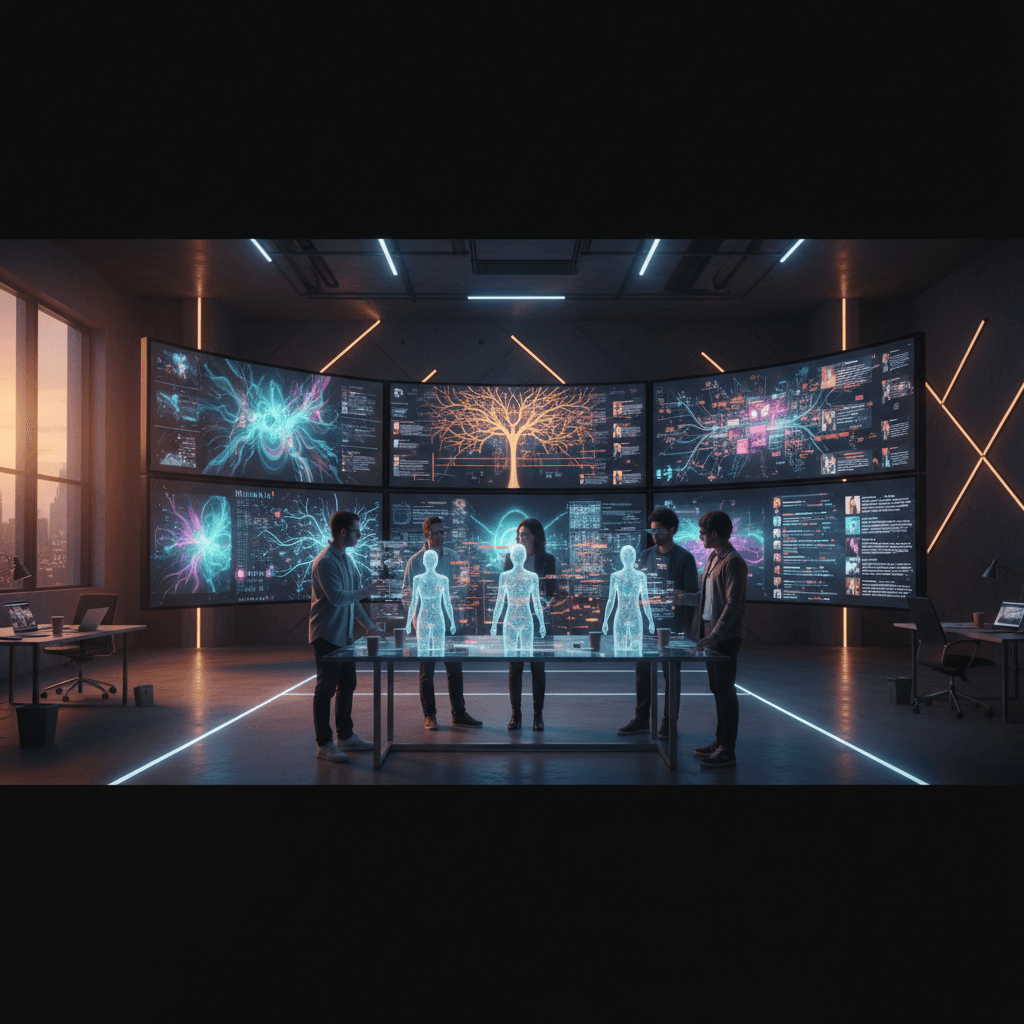
How Veo 3, Sora 2 & AI Agents Will Rewrite Marketing
In 2025, vibe is a data problem.
Every scroll on TikTok, every watch on YouTube, every swipe on Reels is powered by algorithms trying to predict how something will feel to you. The brands that win are the ones who can translate raw attention into emotion, and emotion into action.
Now a new wave of AI — from Google's Veo 3 to OpenAI's Sora 2 and Microsoft's new Agent Framework — is about to supercharge that entire loop. These tools don't just generate content; they reason in frames, coordinate in agents, and operate at a scale that looks a lot like the creative department, media team, and data science function all rolled into code.
This post, part of our Vibe Marketing: Where Emotion Meets Intelligence series, breaks down what these shifts mean for marketers and founders:
- Why Veo 3's "chain-of-frames" reasoning could be the ChatGPT moment for video
- How OpenAI's Sora 2 is colliding with AI TikTok vibes and deepfake backlash
- Why Microsoft killing AutoGen to launch an Agent Framework matters for real-world campaigns
- Concrete ways to start building multi-agent, AI-native marketing systems today
If you care about brand, storytelling, and performance — and you suspect your next creative director might actually be a cluster of AI agents — this is for you.
1. Veo 3: When Video Models Start "Thinking in Frames"
Veo 3 is part of a new class of vision foundation models that aren't just generating pretty clips — they're showing signs of visual reasoning. Marketers don't need to master the math, but you do need to understand the implications.
From prompts to "zero-shot" visual reasoning
Traditional video tools behave like paintbrushes: you describe a scene and they render it. Veo 3 is different. Early demos suggest it can:
- Solve visual tasks it wasn't explicitly trained on (known as zero-shot reasoning)
- Maintain logical consistency across frames (objects, positions, actions)
- Follow multi-step instructions like a "chain-of-frames," not just one-off shots
Imagine you prompt:
"Show a runner starting too fast in a marathon, burning out halfway, then recovering with better pacing and finishing strong. Keep the same character and city, transition smoothly from dawn to midday to sunset."
Instead of three disjointed clips, Veo 3 can reason about time, continuity, and causality — it understands the story, not just the pixels.
Why this feels like a $100T unlock
The $100T number floating around isn't about Veo 3 alone; it's shorthand for the total economic value that could be reshaped when:
- Any brand can produce cinematic, on-message video on demand
- Every touchpoint becomes personalized in real time, down to the scene level
- Testing becomes infinite — thousands of variants, optimized against live behavior
For Vibe Marketing, that changes the game:
- Emotion at scale: Instead of 3 hero edits per campaign, you generate 300 mood-tuned variations: playful, aspirational, minimal, nostalgic — each targeting a segment's vibe.
- Storyteller + analyst in one: Visual reasoning lets AI not only make a beautiful scene, but keep it logically tied to your funnel stage and brand promise.
- Speed-to-trend: When a cultural moment breaks on Saturday, you can respond with fully produced video that afternoon, not next month.
How to use Veo-style models in your marketing now
Even before Veo 3 is mainstream, you can design your workflows as if these capabilities exist, so you're ready:
-
Write prompts like storyboards, not slogans
Specify:- Characters and arcs (who changes and how)
- Emotional beats (tension, relief, triumph)
- Transitions (scene A leads to B because…)
-
Map frames to funnel stages
- Frame 1–3: Awareness — mood, lifestyle, world-building
- Frame 4–7: Consideration — product in context, social proof
- Frame 8–10: Conversion — clear offer, low friction action
-
Plan for variant testing at the "vibe" level
Test differences like:- Lighting: warm vs cool
- Pace: fast-cut vs slow, cinematic
- Music/emotion: high-energy vs calm & confident
You're not just prompting AI to "make a video." You're architecting feelings across time.
2. Sora 2, AI TikTok, and the Deepfake Dilemma
If Veo 3 is the engine, OpenAI's Sora 2 experiments look like the distribution layer: a video generation system wrapped in a TikTok-style feed. That's where internal backlash reportedly begins.
The promise: social-native video, from text
Sora 2-like experiences give marketers:
- Instant, social-ready vertical content from prompts
- A built-in discovery mechanism fueled by engagement data
- A feedback loop where prompts, performance, and user behavior co-evolve
For Vibe Marketing, this is a dream: you can test hundreds of micro-vibes (edgy, wholesome, surreal, luxury) and see what resonates — then spin winning patterns into bigger campaigns.
The backlash: when vibes become deepfakes
Inside OpenAI and across the industry, there's growing concern about:
- Deepfake celebrities and executives used in viral clips
- Misleading "user-generated" content that is entirely synthetic
- Emotionally manipulative content that feels human but is fully AI-engineered
That viral clip of a Sam Altman "stealing GPUs" hitting millions of views is funny — until you realize how easy it becomes to fabricate any scenario, about any public figure, any brand.
For marketers, the risk is clear:
- Your brand face can be hijacked with convincing fake content
- Trust can erode fast if audiences think nothing is real
- Platforms and regulators are moving toward disclosure and watermarking requirements
How to stay on the right side of AI TikTok
To protect and amplify your brand's vibe, not destroy it, adopt a few rules now:
-
Set a synthetic content policy
Decide where you will and will not use AI faces, voices, and bodies. Be especially cautious with:- Imitating real people (founders, influencers, customers)
- Fabricating "testimonials" or fake social proof
-
Disclose without killing the magic
You can use light disclosures like "AI-styled visuals" or "AI-assisted story" while keeping the narrative strong. The new luxury is honest craft, not pretending AI didn't help. -
Lean into co-creation, not deception
Let your community shape prompts, vote on styles, or remix AI outputs. This transforms AI TikTok from "deepfake machine" into collaborative storytelling and strengthens your community vibe.
AI video is not just about what you can do. In Vibe Marketing, your ethics are part of your emotional signature.
3. Microsoft's Agent Framework: Beyond AutoGen to Real AI Teams
Microsoft quietly killed AutoGen and rolled its ideas into a broader Agent Framework that also absorbs pieces of Semantic Kernel. Translation: they're betting big on multi-agent systems — networks of AI "workers" that coordinate like a team.
From single chatbots to coordinated AI roles
Most brands today use AI as:
- A copy assistant
- A chatbot
- A summarizer
Multi-agent systems reframe this. Instead of one model doing everything, you get:
- A Strategy Agent defining campaign objectives
- A Creative Agent generating scripts, hooks, visuals
- A Media Agent planning channels, formats, budgets
- A Data Agent reading performance and optimizing
The Agent Framework provides the plumbing: messaging, memory, tools, and rules so these agents can talk to each other, call APIs, and act.
Why this matters for marketers
Think of it as building an AI-native marketing org:
- Always-on experimentation: Agents continuously test new creatives, prompts, and audiences.
- Closed-loop optimization: Results flow back into the system, updating prompts and strategies.
- Human-in-the-loop control: You approve direction and guardrails, while agents handle the grunt work.
This is the infrastructure layer behind Vibe Marketing at scale — machines monitoring and tuning the emotion + performance balance in real time.
A simple blueprint for your first marketing agent squad
You don't need Microsoft's full stack to think this way today. You can design a conceptual system and implement parts with existing tools.
Example 4-agent setup for a launch campaign:
-
Audience Insight Agent
- Inputs: CRM segments, past campaign data, social comments
- Output: Personas, pain points, emotional triggers
-
Vibe Creative Agent
- Inputs: Brand guidelines, audience insights
- Output: Message pillars, video prompts for Veo/Sora-style tools, hook variations
-
Distribution Agent
- Inputs: Platform constraints, budgets
- Output: Posting schedule, format mapping (TikTok, Reels, Shorts, Stories), initial targeting
-
Optimization Agent
- Inputs: Performance metrics (watch time, CTR, saves, shares)
- Output: Updated prompts, new variations, budget reallocation suggestions
Your role becomes creative director + ethicist of the AI team — steering direction, protecting brand integrity, and deciding which vibes are on or off-limits.
4. Turning These AI Shifts into Real Vibe Marketing Systems
Powerful tools mean nothing without operational habits. To translate Veo 3, Sora 2, and agent frameworks into actual leads and revenue, you need structure.
Step 1: Define your brand's vibe architecture
Before you scale with AI, get precise about:
- Core emotions: What should people feel? (Secure, inspired, rebellious, cared for?)
- Contextual moods: How does that emotion show up on TikTok vs LinkedIn vs email?
- Hard lines: Vibes you never want to trigger (fear, shame, urgency that feels exploitative)
Document this as your Vibe Operating System. This becomes your prompt library and guardrail set for agents and video models.
Step 2: Build an AI-first creative flywheel
Design a repeatable cycle:
-
Discover
- Use agents to scan comments, trends, and search queries
- Identify emotional patterns and unmet desires
-
Generate
- Use Veo-style models for multiple video narratives
- Align each narrative to a specific emotional outcome and funnel stage
-
Distribute
- Deploy via shorts, stories, and feeds that match each vibe
-
Measure
- Track both hard metrics (CTR, conversion) and soft signals (saves, replays, positive sentiment)
-
Refine
- Agents update prompts, scenes, pacing, and messaging based on what hits
Over time, this turns into a self-improving marketing organism tuned around emotion.
Step 3: Bake in ethics and authenticity from day one
To make AI-led marketing sustainable:
- Disclose clearly when content is AI-assisted, especially if it looks hyper-real
- Avoid synthetic humans for claims, endorsements, or anything that implies lived experience
- Prioritize stories that add real value — education, inspiration, or genuine entertainment, not just clickbait
The more powerful AI tools become, the more valuable trust becomes. In Vibe Marketing, trust is the ultimate conversion rate multiplier.
Conclusion: The Next Creative Director Is a System, Not a Person
Veo 3's visual reasoning, Sora 2's social video experiments, and Microsoft's Agent Framework are not isolated news items. Together, they form the outline of a new reality:
- Video models that can think in frames, not just render pixels
- Social-native AI content engines that amplify both creativity and risk
- Multi-agent systems that operate like an AI-native marketing organization
For marketers, founders, and creators, the move now is to start designing your stack and your standards:
- Architect how you want AI to feel in your brand — your unique vibe
- Decide what emotional journeys you want your audience to experience
- Build lightweight agent workflows that turn insight into story, and story into results
The brands that win the next few years won't just adopt new tools. They'll choreograph emotion + intelligence into a system that runs every day, on every platform, in every format.
The question is: when your future customers scroll in 2026, will the vibe they feel belong to you — or to the brands that learned to think in frames and act in agents before you did?